Quan Wellbeing
Role
Lead Product Designer
Year
2016–2020
Quan is a science-backed B2B wellbeing platform helping teams measure and improve their wellbeing — built on validated psychological research rather than wellness trends. I joined as founding designer in December 2020, when Quan was an idea — and stayed through four product versions, $1.15M in Y Combinator backing, a $3M seed round, enterprise clients including PayPal, ASML, and Bynder, and ultimately acquisition by TrueTribe.
Design for growth at scale
88% adoption
Acquired by TrueTribe
The Challenge
Turning wellbeing into a trusted team practice.
Quan needed to balance scientific credibility with human warmth—and create sustained engagement in a category where adoption was typically around 20%.
Outcome
- 88% user adoption vs. a 20% industry benchmark
- 94% platform engagement
- 30% improvement in key team wellbeing indicators
- Scaled to enterprise clients including PayPal
- Acquired by TrueTribe in 2025
My Role
As Quan’s founding designer, I led product design and strategy across every stage of the journey.
My work spanned research, UX, service design, behavioural design, proposition development, and go-to-market strategy. I also mentored designers and helped establish the design practices needed for the product and team to scale.
The Approach
Research kept correcting the aimQuan began by exploring how individual employees could build healthier habits. Continuous discovery showed that team leads have a strong impact on employee wellbeing. This shifted the product from an individual wellbeing tool to a team-centred experience.
Designing for behaviour changeWorking with Quan’s in-house neuroscientists, we combined principles from the COM-B and BJ Fogg behaviour-change models. We created rituals that helped teams turn awareness into conversation, action, and sustainable habits.
Trust by designIndividual responses remained anonymous, with team-level insights only appearing once at least three people had completed an assessment. This approach gave teams enough shared insight to recognise patterns and act together.
The Work
V1 — Validating the propositionI facilitated design sprints, tested early concepts, and established the core experience for Quan’s first product launch. We began with the question:How might we help employees build habits that improve their wellbeing across their work and personal lives?V2 — Shifting from individuals to teamsResearch revealed team culture, relationships, and management behaviours had a significant influence on wellbeing.
We repositioned teams and team leads as the primary users, contributing to a 15% improvement in key wellbeing indicators, including burnout, workplace stress, and work–life balance.V3 — Enabling meaningful conversationsResearch uncovered team leads wanted to support their teams but lacked the confidence and structure to discuss wellbeing.
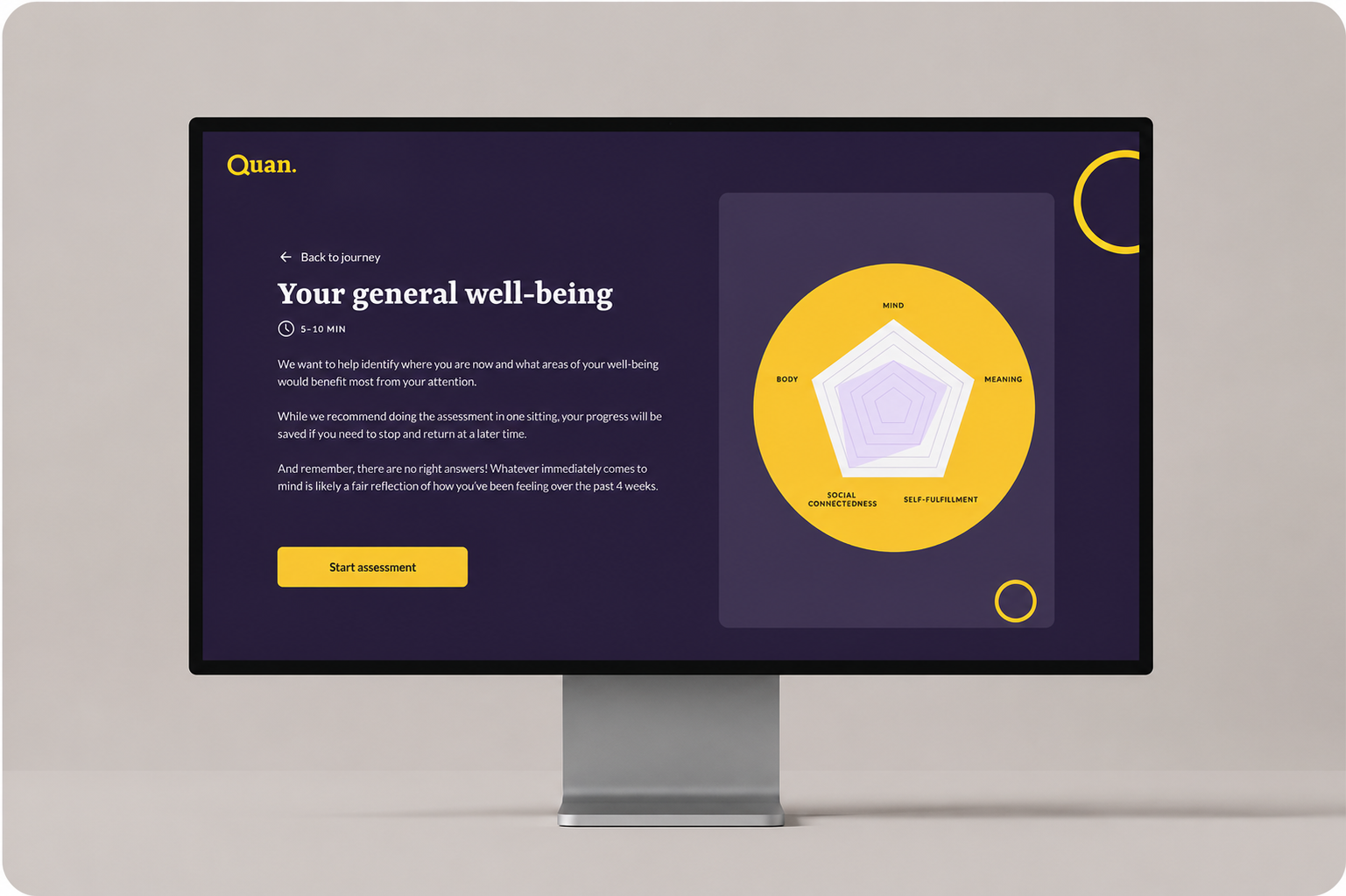
I designed the Wellbeing Retro, a guided ritual to transform anonymous insights into constructive conversations and team actions. This version contributed to 88% user adoption, 30% improvement in team wellbeing and expansion into enterprise clients such as PayPal
V4 — Designing for enterprise scale
As Quan moved into its automation and scaling phase, I led discovery and design for new enterprise customers and insurance partnerships.
I also designed organisational wellbeing reports that translated anonymous team data into meaningful, actionable insights for HR leaders and decision-makers.
Five years, four product versions, and one successful exit—showing what design can achieve when it shapes the product from the first question to the final signature.
Arosha Brouwer
Founder Quan (YC, acquired)
Pelin can take a complex problem, break it down, and curate insights based on rich analysis. Over four years, she has produced a tonne of 'a ha' moments that made us rethink our product and GtM.

Lucy Howie
Founder Quan (YC, acquired)
Pelin brings together multi-facet skill sets in design, design strategy, UX/UI, design leadership, with a focus on being human centred in her approach.
Let's work together
/
Quan Wellbeing
Role
Lead Product Designer
Year
2016–2020

Quan is a science-backed B2B wellbeing platform helping teams measure and improve their wellbeing — built on validated psychological research rather than wellness trends. I joined as founding designer in December 2020, when Quan was an idea — and stayed through four product versions, $1.15M in Y Combinator backing, a $3M seed round, enterprise clients including PayPal, ASML, and Bynder, and ultimately acquisition by TrueTribe.
Design for growth at scale
88% adoption
Acquired by TrueTribe
The Challenge
Turning wellbeing into a trusted team practice.
Quan needed to balance scientific credibility with human warmth—and create sustained engagement in a category where adoption was typically around 20%.
Outcome
- 88% user adoption vs. a 20% industry benchmark
- 94% platform engagement
- 30% improvement in key team wellbeing indicators
- Scaled to enterprise clients including PayPal
- Acquired by TrueTribe in 2025
My Role
As Quan’s founding designer, I led product design and strategy across every stage of the journey.
My work spanned research, UX, service design, behavioural design, proposition development, and go-to-market strategy. I also mentored designers and helped establish the design practices needed for the product and team to scale.
The Approach
Research kept correcting the aimQuan began by exploring how individual employees could build healthier habits. Continuous discovery showed that team leads have a strong impact on employee wellbeing. This shifted the product from an individual wellbeing tool to a team-centred experience.
Designing for behaviour changeWorking with Quan’s in-house neuroscientists, we combined principles from the COM-B and BJ Fogg behaviour-change models. We created rituals that helped teams turn awareness into conversation, action, and sustainable habits.
Trust by designIndividual responses remained anonymous, with team-level insights only appearing once at least three people had completed an assessment. This approach gave teams enough shared insight to recognise patterns and act together.
The Work
V1 — Validating the propositionI facilitated design sprints, tested early concepts, and established the core experience for Quan’s first product launch. We began with the question:How might we help employees build habits that improve their wellbeing across their work and personal lives?V2 — Shifting from individuals to teamsResearch revealed team culture, relationships, and management behaviours had a significant influence on wellbeing.
We repositioned teams and team leads as the primary users, contributing to a 15% improvement in key wellbeing indicators, including burnout, workplace stress, and work–life balance.V3 — Enabling meaningful conversationsResearch uncovered team leads wanted to support their teams but lacked the confidence and structure to discuss wellbeing.
I designed the Wellbeing Retro, a guided ritual to transform anonymous insights into constructive conversations and team actions. This version contributed to 88% user adoption, 30% improvement in team wellbeing and expansion into enterprise clients such as PayPal
V4 — Designing for enterprise scale
As Quan moved into its automation and scaling phase, I led discovery and design for new enterprise customers and insurance partnerships.
I also designed organisational wellbeing reports that translated anonymous team data into meaningful, actionable insights for HR leaders and decision-makers.
Five years, four product versions, and one successful exit—showing what design can achieve when it shapes the product from the first question to the final signature.
Arosha Brouwer
Founder Quan (YC, acquired)
Pelin can take a complex problem, break it down, and curate insights based on rich analysis. Over four years, she has produced a tonne of 'a ha' moments that made us rethink our product and GtM.
Lucy Howie
Founder Quan (YC, acquired)
Pelin brings together multi-facet skill sets in design, design strategy, UX/UI, design leadership, with a focus on being human centred in her approach.
Other Projects
Let's work together
/
Quan Wellbeing
Role
Lead Product Designer
Year
2016–2020
Quan is a science-backed B2B wellbeing platform helping teams measure and improve their wellbeing — built on validated psychological research rather than wellness trends. I joined as founding designer in December 2020, when Quan was an idea — and stayed through four product versions, $1.15M in Y Combinator backing, a $3M seed round, enterprise clients including PayPal, ASML, and Bynder, and ultimately acquisition by TrueTribe.
Design for growth at scale
88% adoption
Acquired by TrueTribe
The Challenge
Turning wellbeing into a trusted team practice.
Quan needed to balance scientific credibility with human warmth—and create sustained engagement in a category where adoption was typically around 20%.
Outcome
- 88% user adoption vs. a 20% industry benchmark
- 94% platform engagement
- 30% improvement in key team wellbeing indicators
- Scaled to enterprise clients including PayPal
- Acquired by TrueTribe in 2025
My Role
As Quan’s founding designer, I led product design and strategy across every stage of the journey.
My work spanned research, UX, service design, behavioural design, proposition development, and go-to-market strategy. I also mentored designers and helped establish the design practices needed for the product and team to scale.
The Approach
Research kept correcting the aimQuan began by exploring how individual employees could build healthier habits. Continuous discovery showed that team leads have a strong impact on employee wellbeing. This shifted the product from an individual wellbeing tool to a team-centred experience.
Designing for behaviour changeWorking with Quan’s in-house neuroscientists, we combined principles from the COM-B and BJ Fogg behaviour-change models. We created rituals that helped teams turn awareness into conversation, action, and sustainable habits.
Trust by designIndividual responses remained anonymous, with team-level insights only appearing once at least three people had completed an assessment. This approach gave teams enough shared insight to recognise patterns and act together.
The Work
V1 — Validating the propositionI facilitated design sprints, tested early concepts, and established the core experience for Quan’s first product launch. We began with the question:How might we help employees build habits that improve their wellbeing across their work and personal lives?V2 — Shifting from individuals to teamsResearch revealed team culture, relationships, and management behaviours had a significant influence on wellbeing.
We repositioned teams and team leads as the primary users, contributing to a 15% improvement in key wellbeing indicators, including burnout, workplace stress, and work–life balance.V3 — Enabling meaningful conversationsResearch uncovered team leads wanted to support their teams but lacked the confidence and structure to discuss wellbeing.
I designed the Wellbeing Retro, a guided ritual to transform anonymous insights into constructive conversations and team actions. This version contributed to 88% user adoption, 30% improvement in team wellbeing and expansion into enterprise clients such as PayPal
V4 — Designing for enterprise scale
As Quan moved into its automation and scaling phase, I led discovery and design for new enterprise customers and insurance partnerships.
I also designed organisational wellbeing reports that translated anonymous team data into meaningful, actionable insights for HR leaders and decision-makers.
Five years, four product versions, and one successful exit—showing what design can achieve when it shapes the product from the first question to the final signature.
Arosha Brouwer
Founder Quan (YC, acquired)
Pelin can take a complex problem, break it down, and curate insights based on rich analysis. Over four years, she has produced a tonne of 'a ha' moments that made us rethink our product and GtM.
Lucy Howie
Founder Quan (YC, acquired)
Pelin brings together multi-facet skill sets in design, design strategy, UX/UI, design leadership, with a focus on being human centred in her approach.
Other Projects
Let's work together
/
Quan Wellbeing
Role
Lead Product Designer
Year
2016–2020
Quan is a science-backed B2B wellbeing platform helping teams measure and improve their wellbeing — built on validated psychological research rather than wellness trends. I joined as founding designer in December 2020, when Quan was an idea — and stayed through four product versions, $1.15M in Y Combinator backing, a $3M seed round, enterprise clients including PayPal, ASML, and Bynder, and ultimately acquisition by TrueTribe.
Design for growth at scale
88% adoption
Acquired by TrueTribe
The Challenge
Turning wellbeing into a trusted team practice.
Quan needed to balance scientific credibility with human warmth—and create sustained engagement in a category where adoption was typically around 20%.
Outcome
- 88% user adoption vs. a 20% industry benchmark
- 94% platform engagement
- 30% improvement in key team wellbeing indicators
- Scaled to enterprise clients including PayPal
- Acquired by TrueTribe in 2025
My Role
As Quan’s founding designer, I led product design and strategy across every stage of the journey.
My work spanned research, UX, service design, behavioural design, proposition development, and go-to-market strategy. I also mentored designers and helped establish the design practices needed for the product and team to scale.
The Approach
Research kept correcting the aimQuan began by exploring how individual employees could build healthier habits. Continuous discovery showed that team leads have a strong impact on employee wellbeing. This shifted the product from an individual wellbeing tool to a team-centred experience.
Designing for behaviour changeWorking with Quan’s in-house neuroscientists, we combined principles from the COM-B and BJ Fogg behaviour-change models. We created rituals that helped teams turn awareness into conversation, action, and sustainable habits.
Trust by designIndividual responses remained anonymous, with team-level insights only appearing once at least three people had completed an assessment. This approach gave teams enough shared insight to recognise patterns and act together.
The Work
V1 — Validating the propositionI facilitated design sprints, tested early concepts, and established the core experience for Quan’s first product launch. We began with the question:How might we help employees build habits that improve their wellbeing across their work and personal lives?V2 — Shifting from individuals to teamsResearch revealed team culture, relationships, and management behaviours had a significant influence on wellbeing.
We repositioned teams and team leads as the primary users, contributing to a 15% improvement in key wellbeing indicators, including burnout, workplace stress, and work–life balance.V3 — Enabling meaningful conversationsResearch uncovered team leads wanted to support their teams but lacked the confidence and structure to discuss wellbeing.
I designed the Wellbeing Retro, a guided ritual to transform anonymous insights into constructive conversations and team actions. This version contributed to 88% user adoption, 30% improvement in team wellbeing and expansion into enterprise clients such as PayPal
V4 — Designing for enterprise scale
As Quan moved into its automation and scaling phase, I led discovery and design for new enterprise customers and insurance partnerships.
I also designed organisational wellbeing reports that translated anonymous team data into meaningful, actionable insights for HR leaders and decision-makers.
Five years, four product versions, and one successful exit—showing what design can achieve when it shapes the product from the first question to the final signature.
Arosha Brouwer
Founder Quan (YC, acquired)
Pelin can take a complex problem, break it down, and curate insights based on rich analysis. Over four years, she has produced a tonne of 'a ha' moments that made us rethink our product and GtM.
Lucy Howie
Founder Quan (YC, acquired)
Pelin brings together multi-facet skill sets in design, design strategy, UX/UI, design leadership, with a focus on being human centred in her approach.
Other Projects
Let's work together
/